Saturday, August 27, 2016

Prince William Sound - Glacier & Wildlife Cruise

Our wish come true!! Not right away, but when we got up this morning, even though there was a thick layer of fog over the RV park, we could see blue sky above and the forecast was for a sunny day. It couldn't have happened on a better day because this morning the Caravan loaded onto a cruise ship (there was a promise that we would be in the calm waters of Prince William Sound and I took two dramamine) for a seven hour journey.

To get the full benefit of the pictures, remember to click on the picture to enlarge it!

Boarding the Valdez Spirit, a catamaran. See the blue sky??!!

This commercial boat struck a cord.

The oil tanks on the side of the hill in Valdez harbor. You can still see some of the fog right above the water.

Glaciers abound on the tops of the mountains that surround Valdez. They produce these beautiful waterfalls that line the Valdez Arm of Prince William Sound. 

Looking back at the Port of Valdez and the magnificent mountains that surround the city.

Another waterfall and a wisp of fog.

A bald eagle enjoying the sun, too.

Along the Valdez Arm.

This waterfall was named for someone but I don't remember who.

Approaching the end of Valdez Arm and getting ready to...

turn the corner around Heather Island and...

enter Columbia Bay, a fjord.

Columbia Bay is home to...

Columbia Glacier, the largest tide-water glacier in Prince William Sound.

The mountains that give birth to Columbia Glacier.

Columbia Bay is filled with ice bergs that are home to Harbor Seals and...

sea otters.

Harbor seal entering the water as we pass by.

Mountains and Columbia Glacier with ice bergs in the foreground.

Remember, only one tenth of an iceberg is above water.

Columbia Glacier has been in 'catastrophic retreat,' in recent years. Notice the scoured face of the surrounding cliffs that were covered by the glacier until recently.

Columbia Glacier has been filling its fjord with millions of tons of ice a day in recent years.

A mile wide and rising 300 ft from the waterline at its face.


As we traveled from one lobe of the glacier to another we passed many more Harbor Seals enjoying the sun.

Another lobe of Columbia Glacier that we could approach more closely because there were fewer ice bergs in the water.

But, there were still enough to give these Harbor Seals a home.

More lobes of the Columbia Glacier.
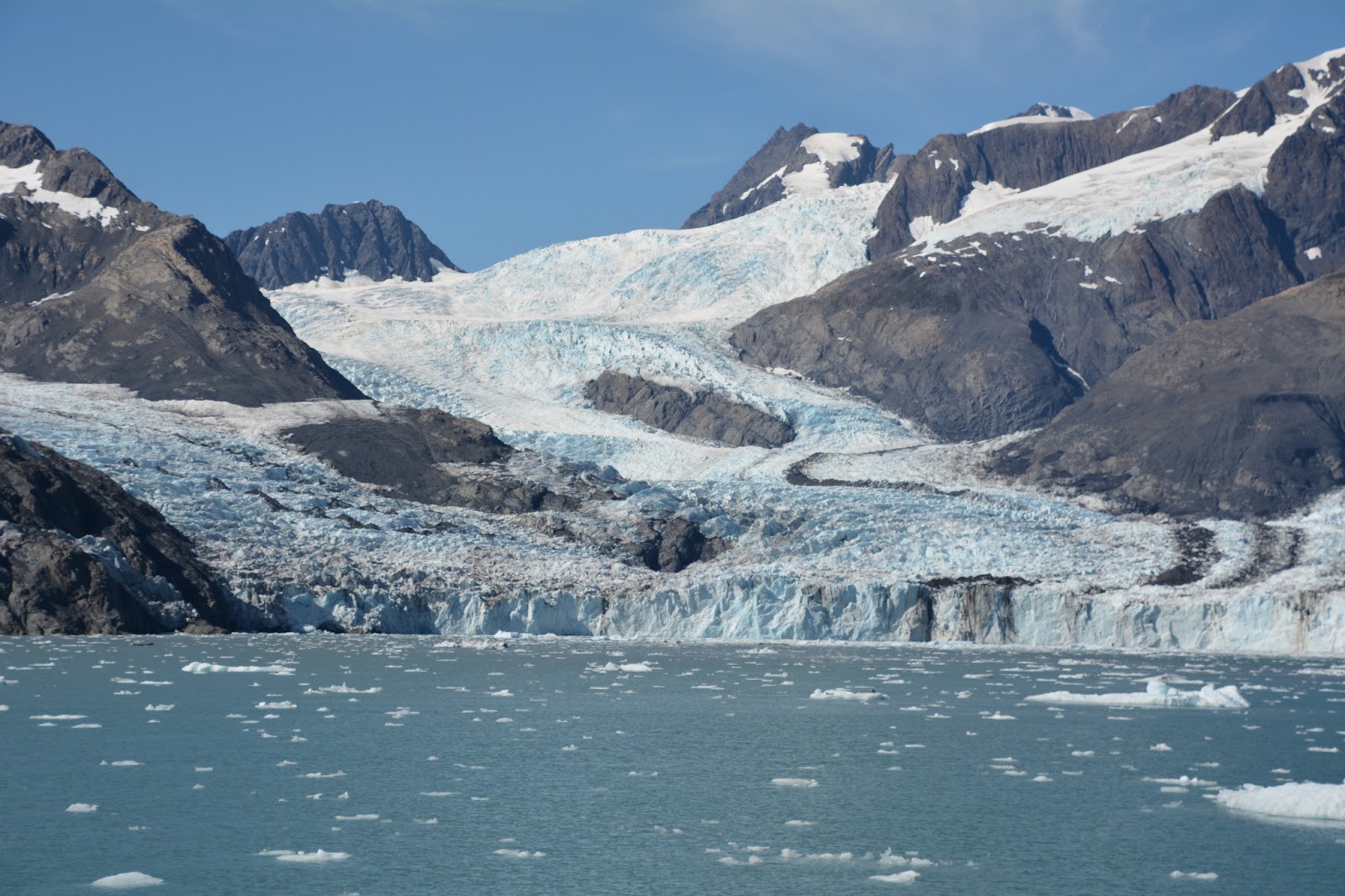
The face of this lobe is only 200 ft and we are half-a-mile away at this point.

Folks on the boat observing the glacier.

Close-up of the glacial lobe on the left.

Ice bergs at the base of the glacier.

On the trip back up the Valdez Arm we passed a colony of Steller Sea Lions on a beach. That's the bull on the rock surrounded by his harem.

We could hear them vocalizing and understand why they are called sea lions.

If you have clicked on the picture to make it larger, you might notice that there is a Harbor Seal to the right of the herd of sea lions - right at the water line. Quite a difference in size!

Steller Sea Lions enjoying the sunny day.

We were also fortunate to see a whale cavorting in the water.


And his tail. (Be sure to click on the picture to get the "full picture")

It was a beautiful day with unforgettable scenery.

When we got off the boat, this bunny was enjoying his dinner. Valdez appears to be over-run with bunnies of all colors.

The Valdez Spirit. She was a good ship!

Thursday, August 25, 2016

Glen Highway, Richardson Highway and the Whitney Museum - we must be in Valdez!

We long for sunshine! That would mean it isn't raining and we would have been able to enjoy the scenery on the drive along the Richardson and Glen Highways today. Fortunately, we will be driving back north on the Richardson Highway on our way back to Canada, so we'll get another chance to see the incredible mountains, glaciers and waterfalls. In the meantime, here's how we saw them today, in the rain.

Heading out of Palmer this morning at 7 a.m. with clouds in the valley.

The leaves on the deciduous trees along the higher elevation Glenn Highway out of Palmer are definitely changing color. It reminds me of New Hampshire in early October.

Matanuska Glacier that heads in the Chugach Mountains and trends northwest 27 miles. The glacier's average width is 2 miles; at its terminus it is 4 miles wide. It is the biggest road-accessible glacier in Alaska. We didn't, but others on the Caravan had driven here yesterday to walk on the glacier.

Along a winding section of the Glenn Highway.

Since we de-camped so early we stopped for breakfast along the way. Our Driver's Manual, which has our daily itinerary, always lists a good breakfast stop along the drive. Since our Leader, JJ, is partial to cinnamon rolls, he always mentions if a stop has good cinnamon rolls. Today's stop not only had good rolls, but they were also Alaskan sized! The coffee was $0.25 a cup.

After we turned south on the Richardson Highway we passed the Worthington Glacier.

Another view of the Worthington Glacier.

Snow poles along the highway guide snow plows in winter.


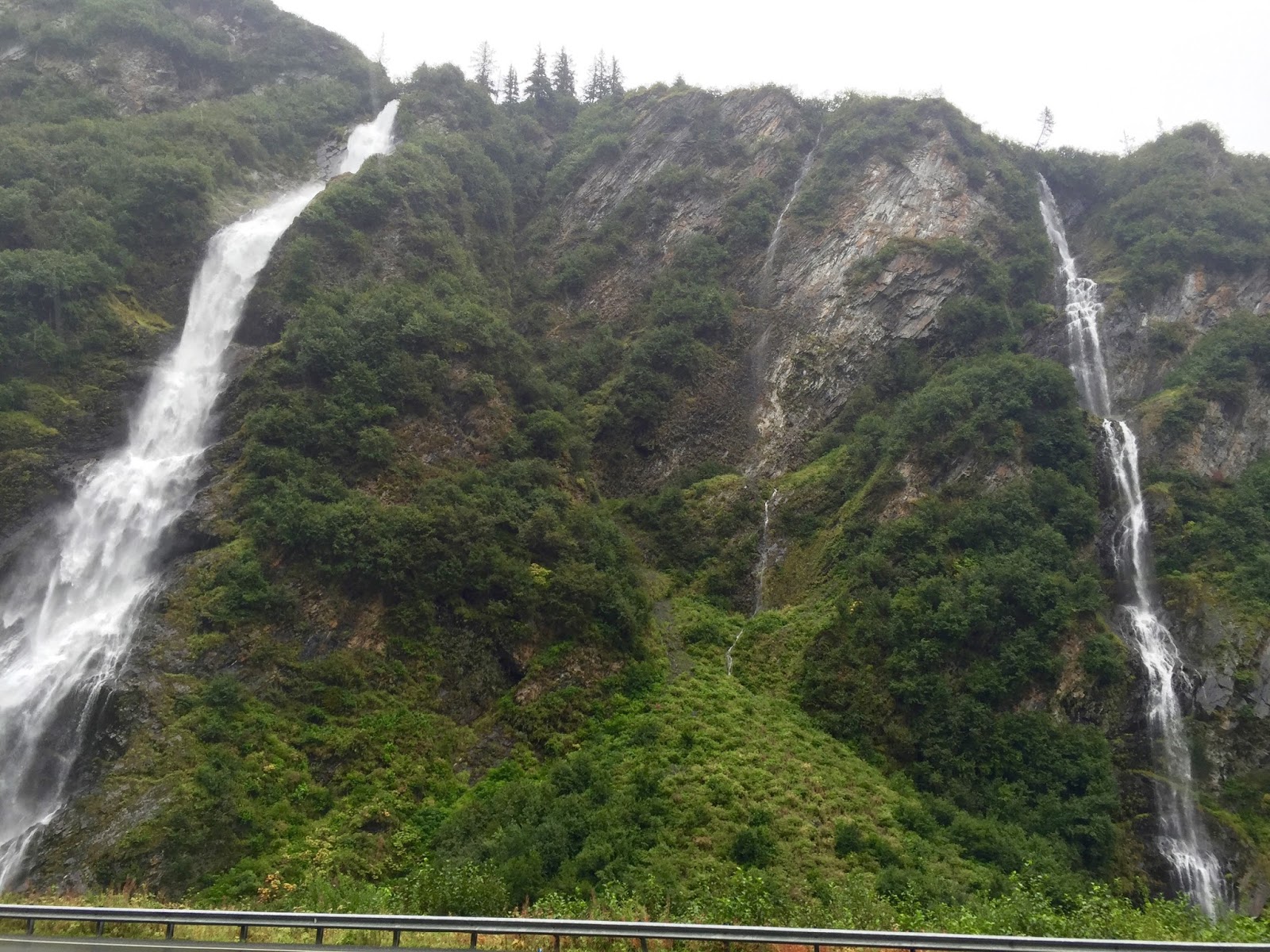
Approaching Valdez we passed through Keystone Canyon where there were waterfalls left and right.

This one is called Bridalveil Falls, (Frederick is there for scale), and a quarter mile further along the highway is...

Horsetail Falls.

Frederick is in the picture for scale.

We arrived in Valdez and hour and a half before we could enter the campground so we drove to the Maxine & Jesse Whitney Museum in town. This "high-quality" museum is devoted to Alaska Native culture and Alaskan wildlife, and features ivory and baleen art-work, moose-antler furniture, and natural-history displays, including some very creative taxidermy. 

Bill! Bill! - look, look!!

More cool stuff for Bill.

Frederick admiring a 2400 pound moose.

Caribou on the left, Dall sheep on the right and Frederick just escaping the clutches of the Polar Bear.

Interesting artifacts.

"Making a living from making art -
Contact with non-Natives dramatically changed the world of Alaska Natives. Whalers and traders brought disease, liquor, and new technology. Missionaries and teachers introduced Christianity, foreign languages, and their own values. By the turn of the century, many Alaska Natives who were reliant on non-Native food and goods to survive sought out paid work.

At the time, there weren't a lot of jobs for men, and there were even fewer for women. Those who saw opportunity in making art for the market turned to skin sewing and basket weaving to supplement their income. At the suggestion of traders, Yup'ik women learned how to make coiled baskets - a hot item among collectors." 


Carvings from ivory and whalebone.

After our last visit to the Alaskan Museum at the University of Alaska in Fairbanks, our favorite Anthropologist challenged us with a few terms and names.  Here they are:
  Tootuks
  Mukluks
  Nevroks
  Ivar Skarland
  Otto Geist
  Sedna 
and, for extra credit - Kazighi

We only knew one of the terms - mukluks - those high top, flat soled, boots/slippers. But today, we asked at the Whitney Museum and the student docent helped us out, his name is Carl Young.

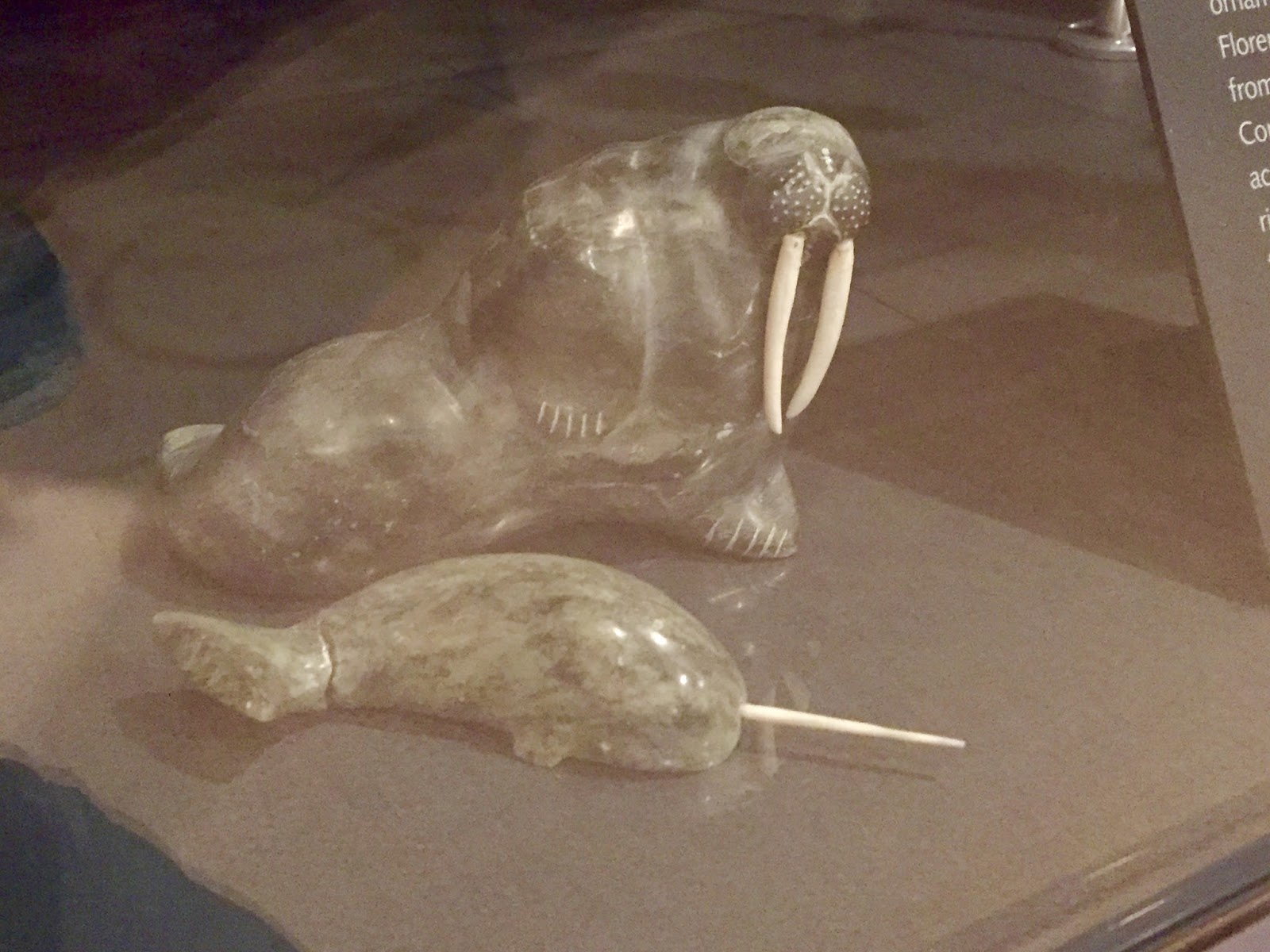
This is an example of Sedna - Inuit sculpture from blue grey stone. This one has ivory tusks.

Tootuks are holes in the nose, ears, lips, for jewelry.
Nevroks - not a clue. We give up! 
Ivar Skarland - a Norwegian Anthropologist who originally studied forestry but came to the University of Alaska. He died in 1965.
Otto Geist was also at the University of Alaska, recruited Ivar Skarland, and they became life-long friends. Professor Geist, an Archeologist, studied circum-polar cultures. He died in 1963. 
For the extra credit - Kazighi are hand tools, maybe some of the items that are in the second picture above, from the Museum.

We also learned about models and miniatures in the Native culture.

 The history of miniatures in Alaska goes way back. They were used for ceremonies and as toys for children. In the 1800s, Alaska Natives started making them as collectibles for anthropologists and museum buyers who wanted to show people back home how Alaska Natives lived. Later, model boats, sleds, and houses became popular items on the tourist market.
Many artists worked in their living rooms at home. Others worked in their own studios or community workshops because dust and noise from motorized carving tools became a nuisance at home. 
Models of sleds and fish traps.

Not a model - snow shoes and dog sled with dogs.

Models

Model

Models of boats.

More Sedna in a display case.