Sunday, November 2, 2014

John Deere

Eero Saarinen, in addition to being a great crossword puzzle answer, is the award -winning Finnish-American architect of the magnificent John Deere & Company World Headquarters, in Moline. The display floor in this architectural masterpiece is a great showcase for new and heritage equipment.

John Deere, a young Vermont blacksmith, settled in Grand Detour, Illinois, in late 1836. In the following year he forged a steel plowshare from a broken saw blade. Deere's steel plow scoured! That is, it passed cleanly through the moist gumbo earth of the Illinois prairie overcoming the tendency of that rich soil to stick to the iron plowshare, a problem that forced the pioneer farmers to stop every few yards and scrape the plowshare clean.

Where other inventors of steel plows faltered, John Deere's entrepreneurial spirit, marketing skills and hard work brought him success. In 1847 he relocated his plow factory from Grand Detour to Moline where it has remained and grown into the nation's leading agricultural implement manufacturer.

The magnificent Eero Saarinen designed Headquarters building. It is in an equally magnificent setting. This is just the central part of the building. There are wings of equal size that are at the left and back side of the building.


Guess what greets visitors?


The display floor is two sided; one has heavy construction equipment and the other farm equipment.

Frederick at the controls of a road grader and front loader.
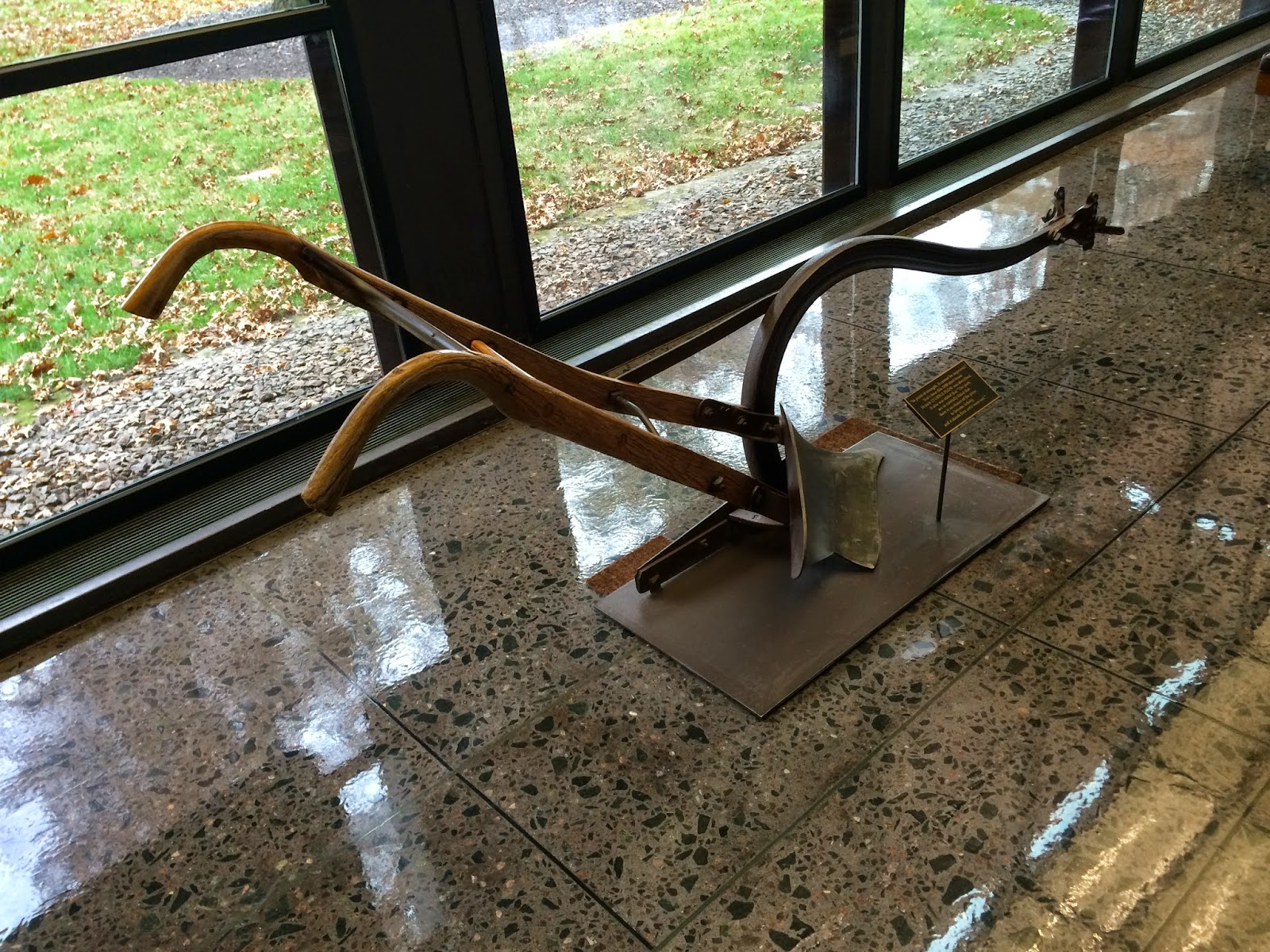
"In point of strength, it cannot be improved," that's how this 1890 steel-beam 14-inch stubble plow was described. Is also was stated that "The parts are so carefully fitted that there is no chance of the plow to become rickety, and it stands firm until worn out."

John Deere's original riding plow, the Gilpin Sulky was one of the company's most successful plows. Its great innovation was that the operator rode behind the plow rather than walking, a feature especially popular with Civil War Veterans who had lost limbs. This model, the New Deere Sulky,  was produced from 1903 to 1929 and is an improvement on the Gilpin Sulky because the wood parts from the original were replaced with steel. Another important feature was that the plow bottom could be lifted by the operator's foot at the end of each furrow, enabling the rig to be easily turned around to start the next furrow while keeping his hands on the reins.

The demand for a small combine was filled with the model 45 combine above. With its introduction in 1954, John Deere created the first combine that could cut and shell the corn in one operation. 

Now look at this beauty! The 606C Corn Head, available in sizes ranging from 6 to 18 rows. This model, as show, retails for approximately $54,778. It has an industry exclusive AutoTrac RowSense row guidance system; combines mechanical row sensors on the corn heads and GPS signal on the combine to provide automated steering. This innovative system automatically steers the combine through the field during harvest without the operator having to manually steer. 

This thresher, Frederick is there for scale, also has the innovative GPS guided system and the approximate retail price, as shown, is $364,071,00.

A plain old tractor but with dual rear wheels (Frederick is there for scale).

Two nice swans in the pond in front of the Headquarters building.

Our next stop was at the impressive Putnam Museum in Davenport. Exhibits reflect the region's history and the archaeology of Egypt, Asia and the Americas. The museum has six permanent exhibit halls including the Hall of Mammals; River, Prairie and People (where we spent most of our time); Asian Gallery and Unearthing Ancient Egypt; and, the Spark! Lab, an interactive space that features STEM ( science,  technology, engineering and math) learning.

In the Spark! Lab is a demonstration of pulleys. Notice the effort this man has to put into lifting his own weight using only one pulley.

But add another pulley and it is much easier!

The Davenport Tablets - fact or fiction?


The River, Prairie & People exhibit begins with an exploration of the life ways of the earliest Quad City residents, the American Indian. This fellow represents the Hunters and Gatherers who were here 6500 B.C. - 1000 B.C. Instead of continually wandering in pursuit of the big-game animals, each family group or small band now moved within its own hunting territory taking advantage of whatever could be hunted, collected, or trapped. The Archaic people became so successful at harvesting the bounty of the forests and rivers that by 1000 B.C., their numbers had greatly increased and they were living in semi-permanent settlements.

There were further exhibits on the Early Potters, 500 B.C.- 200 B.C.; the Hopewll, 200 B.C. - A.D. 500, the Middle Woodland Period; and, the Bow and Arrow Hunters, A.D. 500 - 1200. By A.D 1000, the Oneota culture had developed in the Upper Mississippi Valley. The Oneota lived in large permanent villages along major rivers. They raised corn and other crops in the flood plains, hunted in the forests and on the prairie, fished and collected many wild food plants. Archaeological evidence indicates that the Oneota people were the ancestors of the Ioway, Missouri and Oto tribes.

About 1760 the Sac and Mesquaki moved into this region. They had been forced out of their homes in Wisconsin by fur trade-related conflicts and in turn they pushed the Illini Indians from the lower Rock River Valley. They lived here until the Black Hawk War of 1832.

It is early spring around the year 1810. A fur trader has stopped at one of the Sac or Mesquaki villages located near the Mississippi. Having laid out the trade goods the trader is beginning to buy furs. The young Indian man is hoping for a good price, for to survive he and the people of his band also need the guns and gunpowder, iron knives, awls, fire strikers, and warm blankets brought by the trader.

The exhibits go on through the Civil War period; the immigrants arriving; the First and Second World Wars, up until the 1990s. It is extremely well presented.

One interesting item is Bix Beiderbecke' coronet. Born in Davenport in 1903, by the 1920s Bix was touring with Paul Whiteman's orchestra. He was one of the great musicians of the twentieth century.


Scene from the Hall of Mammals.

Mammals from the polar region.

More mummies from Egypt.

Incredible detailed wrappings.
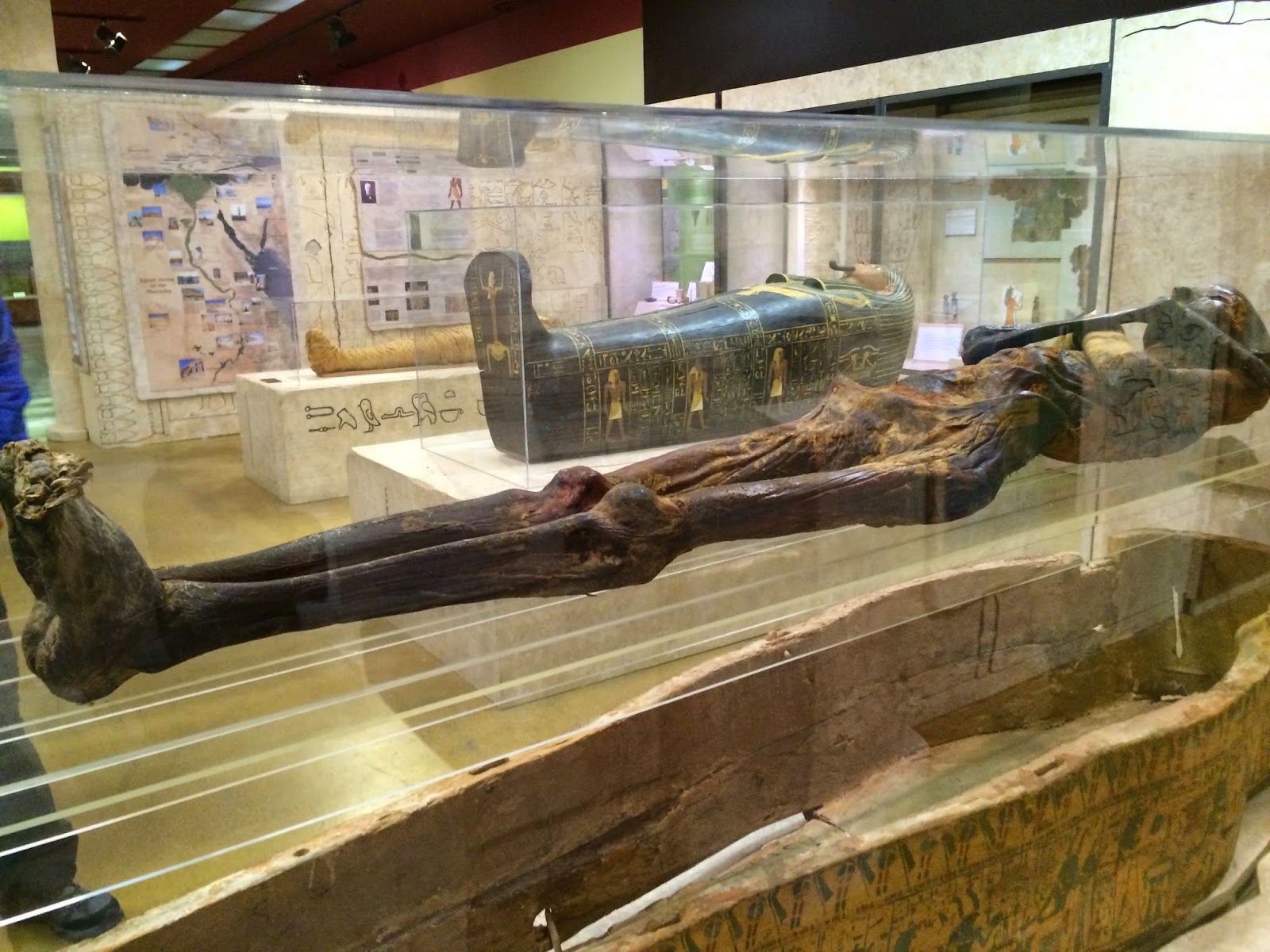
A real mummy, a woman.


Saturday, November 1, 2014

Trees with leaves

The first lock & dam built on the Mississippi in 1931was #15, at Arsenal Island, Rock Island, Illinois. According to Abby, our guide from the Army Corp of Engineers, the purpose of the lock & dam system on the upper Mississippi is to make the river deeper. The upper Mississippi is narrow and, in some places, very shallow. The lock & dam system, all 29 of them, is to guarantee that the river will be 9 feet deep for navigation.

When we went to the Mississippi Visitor Center on Arsenal Island we got to see the lock in operation.

When we arrived, this barge was just leaving the lock heading north.

The north "fill" gates then closed and the drain pipes at the south end opened.

The gage on the side of the lock reads 19 feet.

The lock begins to drain and the north gates leak, just a little.

At the south "drain" end of the lock a barge jockeys into position.

The water drains down to 8 feet in just a matter of 10 minutes and the south gates begin to open.


It takes about 5 minutes for the gates to open.

The south gates are open and the barge begins to move through the lock and the bridge above the lock swings 90 degrees so the tug can pass through the lock.

The barges with tug enter through the south gate.

The water gage is at 8 feet.

Barge and tug making its way through the lock


Barge passing the observation platform.

Almost completely within the lock.


The tug reverses engins to stop the barge within the lock.


The barge and tug are stopped completely within the lock and the bridge swings back 90 degrees.

The front of the barge nestled against the north gate.

The friendly tug operator responding to my wave. He went from being below us to being quite a bit higher than we were on the observation platform.


The south gates close and water begins to enter the lock at the north "fill" end.


While the lock was filling, a 10 minute process, a train crosses the upper level on the bridge.


The barge being raised to almost dock-side level, 19 feet on the water gage, and the north gates begin to open.

The north gates are open and the tug starts moving the barge out.


Moving the barge through the north gates.


Out and away and the gates begin to close for another cycle.

The whole process took less than 30 minutes.

We moved inside the Visitor Center where a tour of the Clock Tower was being organized so we decided to join them.

This is our tour guide, Abby, who works for the Army Corp of Engineers. 

Arsenal Island is between Rock Island and Davenport and is technically part of Rock Island. After the War of 1812, the U.S. decided to build a fort, Fort Armstrong, on the island to protect the settlers from "hostile" Indians. Black Hawk lived in the Sauk town of Saukenuk, located a few miles from the fort. After the Black Hawk Wars, in 1832, the fort burned to the ground in a fire. Then, in 1850, the U.S. decided to build three arsenals - one in Columbus, Ohio, one in Indianapolis, Indiana, and one on Arsenal Island, hence its name. 

The arsenals in Ohio and Indiana have both been converted into vocational High Schools, so the only remaining one is here. Building began in 1863 and was supposed to be completed in 1865, but, as you know, the U.S. was otherwise occupied in 1861-1865 with the Civil War and supplies for the building were difficult to come by. Gen. Rodman arrived in 1864 to supervise the building after Major Kingsbury left in frustration over the slow process. 

At about this time the island was beginning to be use to house Confederate POWs and they were used to build the arsenal. Even after the Confederate Prison closed in 1865, former Confederate soldiers remained to work on the building because of uncertainity of what awaited them at home.


This is the main arsenal building, Building #A, that was completed in 1867. After it ceased to be an arsenal it was referred to as the Clock Tower, a major landmark in the Quad Cities.

Abby explained about the difference between arsenal and armory. An armory is where weapons are made and an arsenal is where they are stored.


Storehouse A was used from the Civil War to after WWI. After WWI other facilities were used and the building was closed to the storage of weapons. It was in danger of being torn down when the local residents mounted a campaign to keep it standing because it had become an important local landmark.


In 1931, when the first lock & dam was being constructed, it was offered to the Corp of Engineers as office space. In subsequent renovations, little historic displays are tucked on the stair landings. This is historic Corp of Engineers surveying equipment.

This is a 1930s office display.


Abby took us on a tour up through five floors and two additional floors to the top of the clock tower.


The top of the tower with the mechanism that operates the four clock faces - north, south, east and west.

The clockworks.

View of the lock through one of the open numbers on the clock face. A barge is just leaving the lock through the north gate.

View up the up the stairwell.

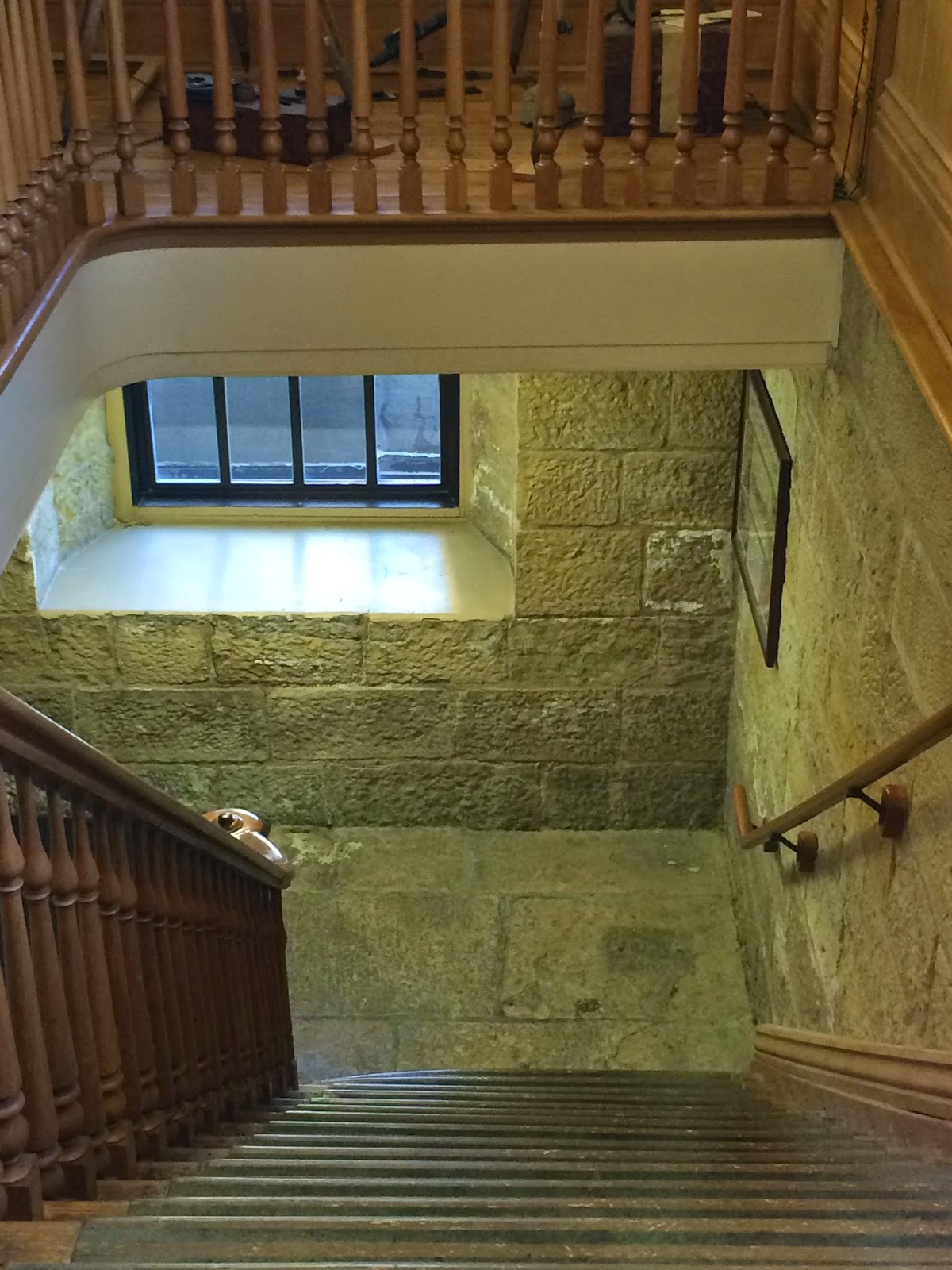
The original construction that shows in the stairway down to the basement.

Arsenal Island is the largest employer in the Quad Cities area, 7,500 people come to work on the island every day. It is the Mississippi Valley Division of the U.S. Army Corp of Engineers Headquarters and the  Headquarters of the 1st Army; military manufacturing continues.

Col. George Davenport arrived on the island in 1816 under contract to provide food to the soldiers building Fort Armstrong. He thus became the first permanent white settler in this area. During the 1820s he was in the fur trade with area tribes and became a wealthy man. After the 1832 Black Hawk War, which ended the local fur trade, he devoted his time and money to developing local communities, including the city across the river named in his honor. Col. Davenport had this home built in 1833. 

This is the Rock Island Confederate Cemetery, the only surviving remnant of a massive prison camp that once held thousands of Confederate soldiers, many of whom died of smallpox.

A little further down the road is the Rock Island National Cemetery which covers 67 acres.