Tuesday, May 6, 2014

Baa

This is our last day in and around Atlanta so we got an early start. Something that we wanted to do while in the south was gain a better knowledge of the Civil War, especially from the southern perspective, for, as it is said, the winners write the history books. We had already gotten a clear understanding that the legacy of the Civil War is still very much present in Georgia. Corny perhaps, but for the last two nights we watched Gone With theWind; it's a long movie. It turns out that it was a decent presentation of the attitudes of the south prior to and after the Civil War and certainly Georgians and the burning of Atlanta.

This morning our first stop was the Atlanta Cyclorama which is located right next to the Atlanta Zoo. The Cyclorama depicts July 22, 1864, one day in the Battle for Atlanta. The painting is 358 feet wide by 42 feet tall and is considered the largest in the world. It is longer than football stadium and taller than a five-story building. The thirty foot distance between the painting and the circulating observation platform is filled with a three-dimensional scene the adds to the realism of the depiction. First we went to an auditorium where a sort film, narrated by James Earl Jones, set the background for the battle for Atlanta. We then moved into the huge room that houses the circular painting. It was quite impressive and reminded me of the cyclorama at Gettysburg.

Also at the museum was the locomotive Texas, one of the two engines that was involved in the Union military raid that attempted to commandeer a train and depicted in the movie The Great Locomotive Chase; the General was commandeered and the Texas gave chase.

The "Texas."

The exterior of the Cyclorama which is right next to the Atlanta Zoo.

We finished in the Cyclorama about 11:30 am, and although it was tempting, we passed up the Zoo and travelled to the Atlanta History Center. John, who gave us the tour of the Plantations at Stone Mountain, had recommended it and I'm glad that he did.  It was a great afternoon.

There are a number of parts to the Center. The Atlanta History Museum, the Swan House and Smith Farm and extensive Gardens. We began in the Museum, and because I'm a big fan of the Olympics, we spent a fair amount of time in the Exhibit Hall - Centennial Olympic Games Museum.  There was a collection of multimedia presentations, artifacts, images and interactive displays that covers not only the 1996 Olympics in Atlanta but the history of the modern Olympic Movement. I thoroughly enjoyed it!

Next we visited the Gallery that houses The Turning Point: The American Civil War. Here is one of the largest Civil War exhibitions in the nation. It tells the story of the Civil War through more than 1,400 original Union and Confederate artifacts, photographs, dioramas, videos, and interactive components. It was the best presentation of the Civil War and Reconstruction I have ever seen. It was presented in a very objective way and it achieved our goal of learning about the war from the view of the south as well as the north. 

We spent almost 2 hours viewing the Turning Point and then we went out of the Museum to see the houses and the gardens. This diversion was needed because the Civil War exhibit was very intense.

The Smith Family Farm is a restored farmhouse and outbuildings including an open-hearth kitchen, blacksmith shop, smokehouse, double corncrib and cabin. There are costumed interpreters in the farmhouse. 

The Smith Family Farm.

These sheep kept up an almost constant baa-ing. I think it was close to suppertime for them.

The cabin.

The Swan House is a classically styled mansion built in 1928 for Edward and Emily Inman. Edward, heir to a large cotton brokerage fortune, died just three years after moving into the house from a heart attack when he was 49. Alone in the large house, Emily Inman asked her oldest son Hugh and his family to live with her. Mrs. Inman lived in Swan House until her passing at age 84 in 1965.  The house, furnishings, and 28-acre estate were purchased by the Atlanta Historical Society in 1966 and opened to the public in 1967. In 2004, the Atlanta History Center completed a four year, $5.4 million restoration of the house and its furnishings. In 2012, Swan House was one of the locations used during the filming of the movie The Hunger Games: Catching Fire.

The Swan House has two entrances - the front garden facade is seen from the street, but the driveway takes the visitor to the rear, where a columned porte-cochere offers a protected and private entrance.

The library.

Dining Room.

The black and white marble floor and curved, free-standing stairway.

Victorian Playhouse on the Swan property.

Stepped-down fountain at the front on the house.

Front of the house as seen from the street.

We then toured four of the six historic gardens.

Rhododendron Garden.

Noisy, croaking frog on a lily pad in the Quarry Garden.

Quarry garden. 

Also in the Quarry Garden that shelters one of the state's most comprehensive collections of plants native to pre-settlement Georgia many of which are rare or endangered.

After visiting the gardens we returned to the Museum and made a quick visit through two more galleries. One on the native peoples of early Georgia and a traveling exhibit, The Kinsey Collection
that explores the historic, artistic, and cultural contributions and progress of African Americans through rare and historic artifacts, document, books, letters, manuscripts, photographs and artwork by African American artists. Many original documents and pictures that I have seen in history books were in the collection.

Moving day tomorrow. We are off to Helen, in the northeast mountains of Georgia. 


Monday, May 5, 2014

Olympic torch

I still remember the 1996 Olympic torch relay through Providence and Malcolm Grear inviting Peter to hold the torch that he designed. Today we explored the 21 acre Centennial Olympic Park, the focal point for the Atlanta Summer Olympics. Lots of other people were enjoying it too, as it is a kind of cross-roads in downtown Atlanta and the Georgia Aquarium borders the park.

Beautiful Olympic Park in Downtown Atlanta.

One small side garden has four of these massive granite (naturally!) blocks with the names of all of the Olympic athletes carved on them according to their event. This side of one of the blocks has the men's and women's 4 IM swimmers. Nice tribute to the athletes.

We were in downtown Atlanta to go on an Inside CNN Studio Tour. The CNN building also borders another side of the Olympic Park. The tour lasted 55 minutes and we came away very impressed with the size of the CNN operation (over 4,000 employees, 2,000 of them in Atlanta), and with all the details that go into broadcasting CNN around the world.

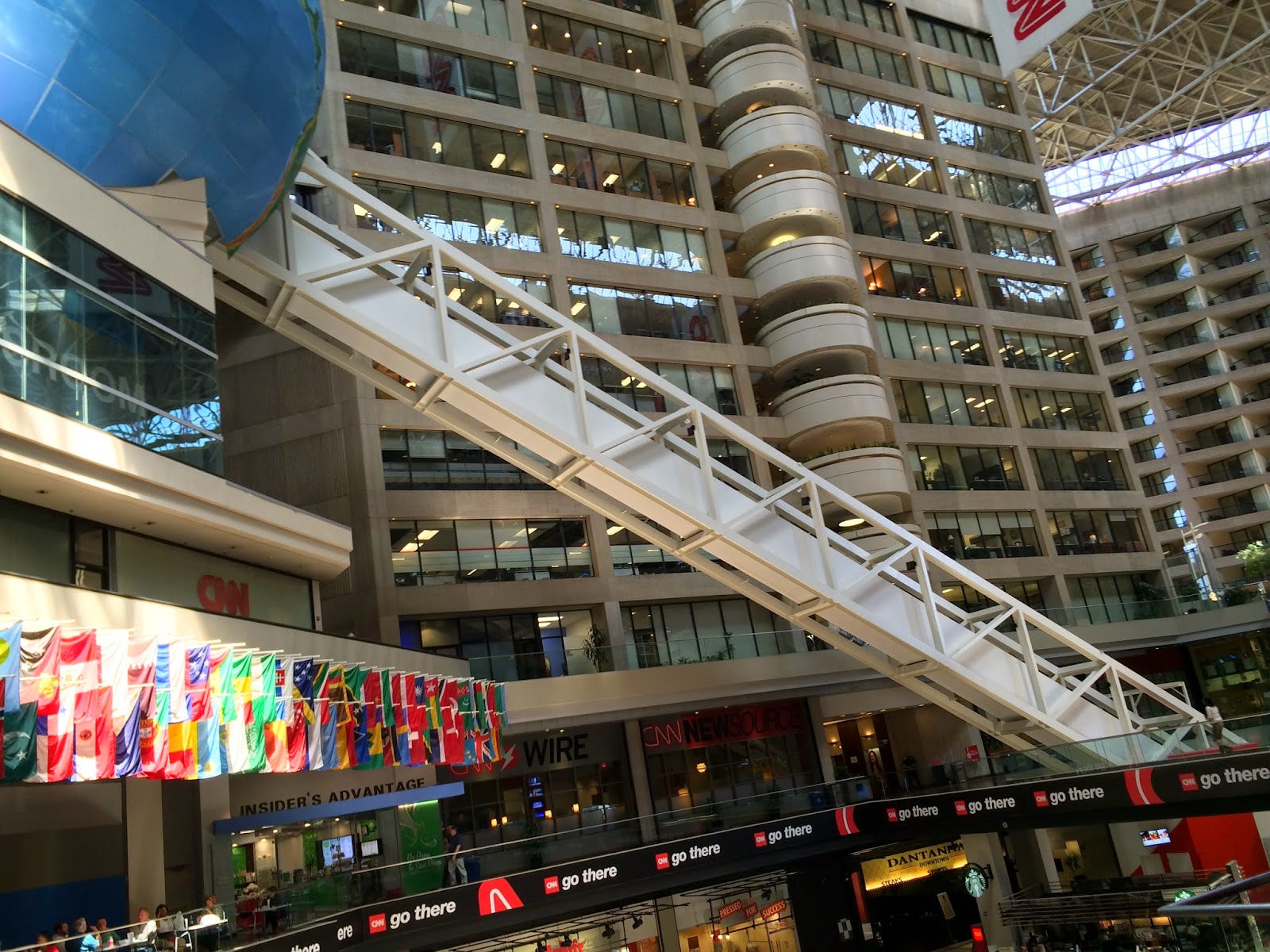
The atrium of the CNN World Headquarters building.  We began our tour inside that globe.

Another view of the atrium.

We got to the globe by ascending this 8-story escalator (192 feet long), the longest unsupported escalator in the world.

The floor of the atrium has the shape of the continents of the world in black tiles. I think you can just make out South America.

Our main stop this afternoon was the Georgia Aquarium, a gift of the founder of Home Depot, Bernard Marcus.  Opening in 2006, it is the world's largest aquarium. It is a 9-acre state-of-the-art facility with a staggering 8 million gallons of both fresh and salt water that contains more than 100,000 different animals, representing over 500 of the planet's marine species.

The aquarium is divided into several marine-life areas. One of my favorites is the Cold Water Quest, a habitat for creatures that thrive in the world's icier seas. Here we saw beluga whales, California sea lions, a giant Pacific octopus and Japanese spider crabs. The OceanVoyager is one of those exhibits where you can walk under the water and see the fish swimming through an acrylic ceiling. Stingrays, whale sharks (the largest species of fish in the world), and groupers swim through this 100-foot long saltwater tunnel. Here are just a few of the pictures I took.

Sea horses.

 A tiny section of this massive wall-sized exhibit of the largest living reef exhibit of any aquarium in the world. Living corals and thousands of colorful reef fish.

A manta ray and  whale shark.

In the Coldwater Quest there were these intriguing creatures - sea dragons.

Turtle.

Albino crocodile in the Georgia Explorer exhibit room.

There was also a dolphin show called "Dolphin Tales" that purported to be "a moving tribute to the connection between humans and dolphins, incorporating actors, amazing effect and an exhilarating musical score, all to educate and entertain the audience and create a memorable experience for all ages." It is pretty amazing what these animals can be trained to do. However, I don't know that I really like the idea of "training" wild animals for entertainment.


Sunday, May 4, 2014

Make way for ducklings

Those of you with sharp eyes may have noticed the yesterday's post was sent fairly early in the evening. That is because we wanted to complete the posting before we left for the "Lasershow
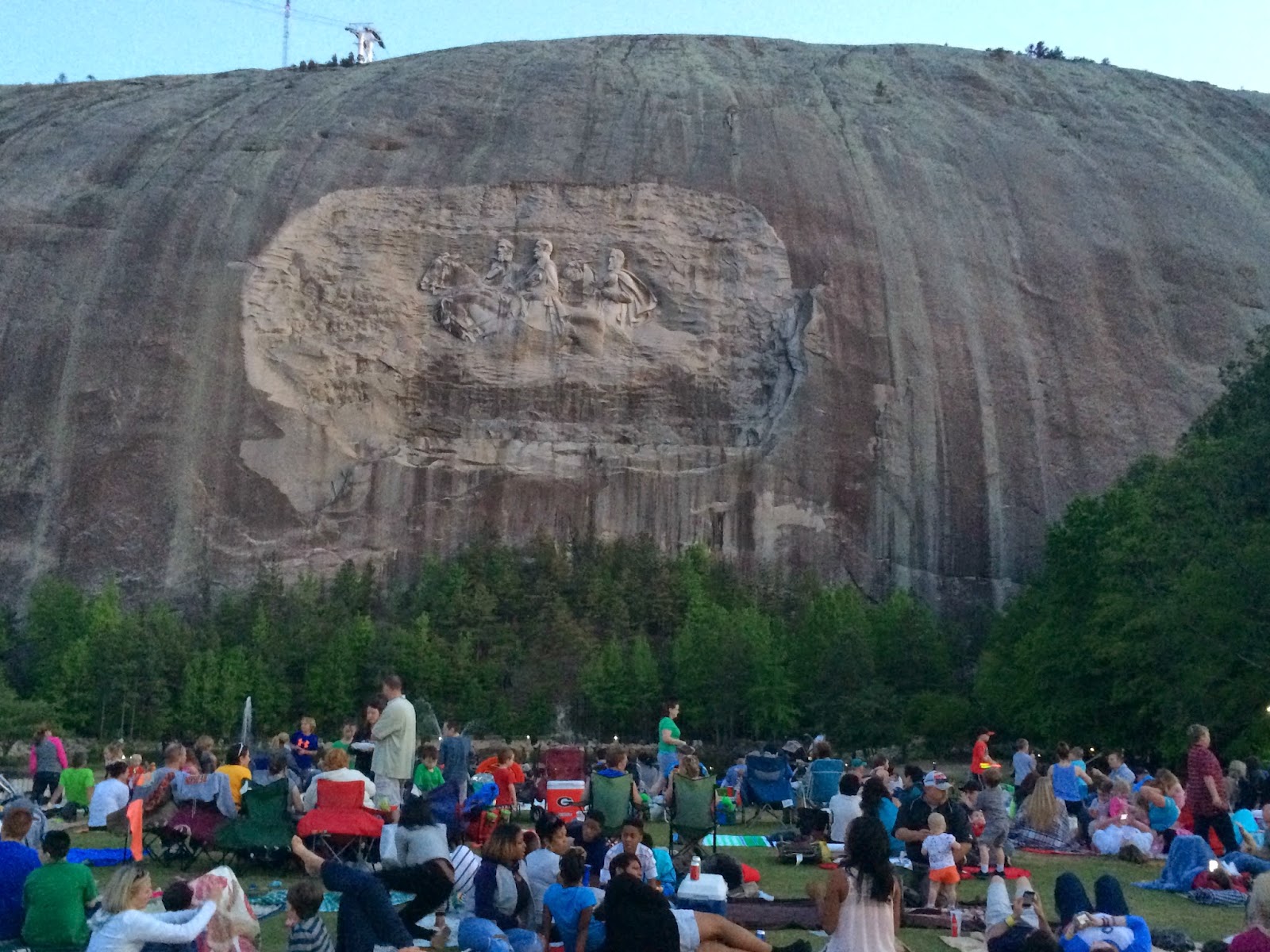
Spectacular in Moutainvision that brings the mountain to life at night with a stunning magical display that offers state-of-the-art graphics and awe-inspiring effects to create multi-dimensional magic on one of the world's largest outdoor screens - Stone Mountain". We haven't mentioned it before but there is a carving on the north side of the mountain. Also on the north side, at the base of the mountain, is a collection of attractions, one of which we will describe further in a moment.  The carving is a tribute to Confederate heroes - General Lee, Jefferson Davis and Stonewall Jackson.  I'm not sure how any of them would feel about the laser show presented on their carving, but the assembled masses sure enjoyed it.

We took a shuttle bus from the campground to the viewing lawn toting our new folding Airstream chairs with us.  That was a very wise decision because all of the parking lots were jam packed. The show began at 9:30pm and we got there about 8:30pm.

The crowd beginning to gather.

Lee in the foreground, Davis on the left and Jackson on the right.

See Frederick in the middle of the picture? Patiently waiting?

Overhead the ariel tram was still operating.

The show is about to begin.

The lighting creates a dramatic effect.

The laser show lasted about 35 minutes and was big on Georgia sports teams, music, and laid back culture.  There was also an interesting depiction of the Civil War from a more southern point of view.  This was all done with lasers and cartoon -like figures and dramatic music.  The final selection was about the military and local heroes -  mostly firefighters. The ending was a prolonged playing of the Star Spangled Banner, we were all asked to stand, and a three minute fireworks display.  It was fun being there with all the other people, many of them multi-generational families with lots of very young children. 

This morning we went back to the base of the mountain to visit one of the attractions that is a small Georgian version of Old Sturbridge Village called Antebellum Plantation at Stone Mountain Park.  It is a collection of original buildings from around the state of Georgia, built between 1792 and 1875.  They were chosen for their authenticity and historical value and representation of the diverse lifestyles of 18th and 19th century Georgia residents.  Each building was moved from its original location in Georgia and carefully restored. 

When we arrived the parking lot was mostly empty even though it was late morning.  At the entrance we asked about a tour and we were told that there was one scheduled for 1pm but that the interpreter, John, was out and about and she would ask him to find us. We had just gotten to the first house when John arrived and preceded to give the two of us a full village tour for the next two hours.  There are 18 separate buildings and John not only explained the houses, but the original families that owned them, and a wonderful description of the culture of the times.  We were so fortunate!

There are three "plantation" mansions on the grounds but only this one fits the stereotype of a plantation mansion.  This is the Dickey House and was on a one thousand acre plantation.

This wing chair is in the Kingston House, a more modest, but still fine, plantation mansion.  This house was on a plantation of only 500 acres.  This wing chair is one of the oldest pieces of furniture in the village, c.1690.

A rare double, connected, chimney on the Thornton House, the third plantation mansion.

This is John outside the slave cabins that were part of the Thornton plantation.

Scott, notice the chimney built with no mortar and semi-detached from the house.

John, slightly out of focus because he moved so fast, explaining the cookhouse for the Dickey mansion. He said that 900 meals a day were prepared in this cookhouse; two meals a day for the family, the slaves and the paid employees. 

We thoroughly enjoyed our visit to Antebellum Plantation. How could we not with such an informed guide!

Then after eating our lunch we started on the Cherokees Trail that circumnavigates Stone Mountain. The trail is about five miles in length and there were many folks that had the same idea.  The trail passes through several other attractions that were being enjoyed on this super fine day.

Families enjoying the water at the old grist mill, another authentic building brought to the park.

A covered bridge.  This lake that is on the north side of the mountain is man made.

As we were nearing the end of our trek we noticed a young family of ducks. 


Saturday, May 3, 2014

Spock's excellent Stone Mountain adventure

Stone Mountain, being a geo site, caused Mr. Spock to be very excited about further exploring the mountain. So off we all went to the top of the monadnock (a hill that stands above the surrounding countryside).  There are three well-know monadnocks in the world; Stone Mountain in Georgia, Mt. Monadnock in New Hampshire and Ayers Rock (Uluru) in Australia. Frederick and I had climber Mount Monadnock two years ago so we told Spock that he was in for a hearty climb, but he was game and we started out in a slow, but steady, pace. It's a mile up and takes about 45 minutes.

Frederick leading the way.

There were two noteworthy spots on the climb.

This section of the trail has two hand rails so you can help pull yourself up the face.

You can see the last part of the trail before the top. Pretty much straight up!

As you can see, a fair number of people took the trail with us.  It was perfect weather for the climb - about 72 degrees with a clear sky.  As usual, there are always some interesting people on the mountain. This guy I found intriguing.  I think he made the climb more than once.

No clue what advantage the breathing apparatus provides.

At the top, we had a bit of a look around, literally, before we ate our lunch.


Spock and Frederick holding on to each other - very windy at the top. Atlanta in the background.

The easier way to get to the top and the reason for the ugly poles and wires on the trail.

One artsy shot.

Yesterday's blog had pictures of the mountain taken from the boat dock in the campground.

Boat dock taken from the mountain.

Shot on the way down.

When we got back we went to the Information Center (called Confederate Hall) and learned more about the geology of the mountain from some very nice exhibits.

Speaking of Confederate, I didn't know that there were three official Confederate flags during the Civil War. At the start of the climb up the mountain, there was an exhibit and explanation of all three.

Three official flags on the right.

The Civil War still seems to be on the mind of the south.


Friday, May 2, 2014

World's largest exposed piece of granite

Most of you know that one of the guides for our trip is Albert Dickas' book, "101 American geo-sites you've gotta see." Each state is included with as least one site; some have two and some overachievers have three, four or more.  California and Wyoming each have five.

Georgia has one site - Stone Mountain, Georgia.  Located just outside Atlanta, 14-miles east of the intersection of I-75 and I-85, the 1,686-foot-high promontory of Stone Mountain, billed as the world's largest exposed piece of granite, dominates the countryside. This is where we are camped for the next five days, Stone Mountain Park Campground.

It was a genuinely lovely drive through central Georgia today.  We were off the interstate for over half the trip and travelled through Georgia's "lake" county and "dairy" county. We hummed along, going about 50 miles-per-hour, passing gorgeous farms and rolling countryside. Pine forests served as a backdrop.  Of course, the fact that the sky was clear blue and the temperature was in the upper 60's and the humidity was down in the 35 - 40% range had something to do with our delight.

Halfway through the drive we stopped at a rest stop -

Lovely front of the rest stop.

We, of course, were in the back.

When we arrived, we set up, found the nearest Sam's and Publix, and set off to get our supplies for the next few days.

Stone Mountain Lake, about 4 campsites away.


First of many pictures of Stone Mountain.

Stone Mountain viewed across the Lake.


Thursday, May 1, 2014

Hills

The most notable observation today was in the change of landscape. From flat, Florida, coastal Georgia and South Carolina, to rolling hills, pine forests and clear lakes, there is a definite change in the landscape. Tonight in Milledgeville, GA it is 61degrees and 59% humidity. It is a lovely evening.

We are on our way to Atlanta and Milledgeville is about halfway between Savannah and Atlanta. It is rural here, a pleasant change from the urban and congested areas we have been in lately.

It's a lovely little campground and we took advantage of the laundromat this afternoon.  Oh, and I gave Frederick a hair cut. A quiet day and just an overnight in the park. Tomorrow we'll be near Atlanta.

Since we are here just overnight, we didn't unhitch.


Not too many here in the park.

Nice little laundromat.  We used all three washers and dryers.


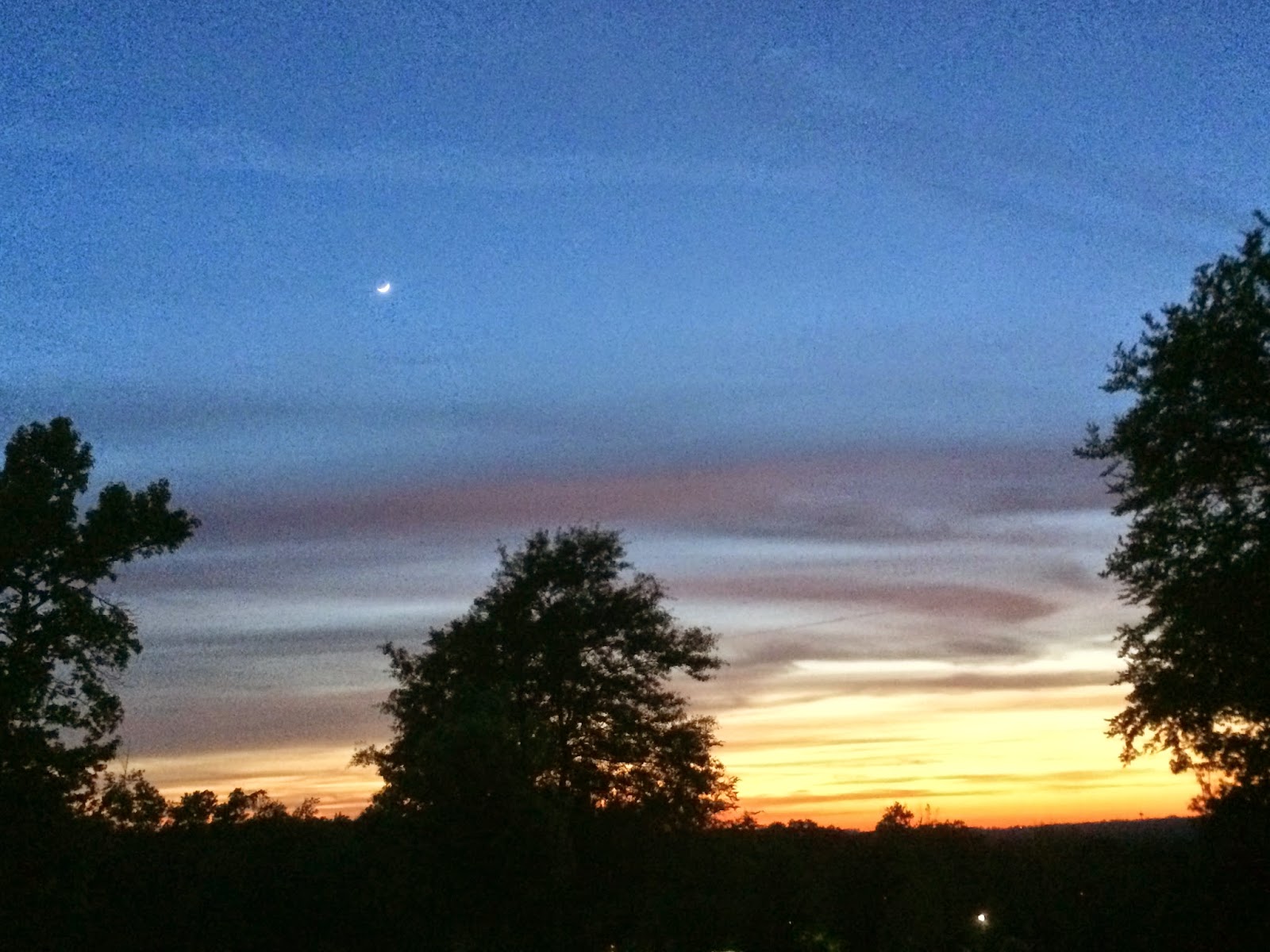
Sunset in Milledgeville, GA


Waxing moon.